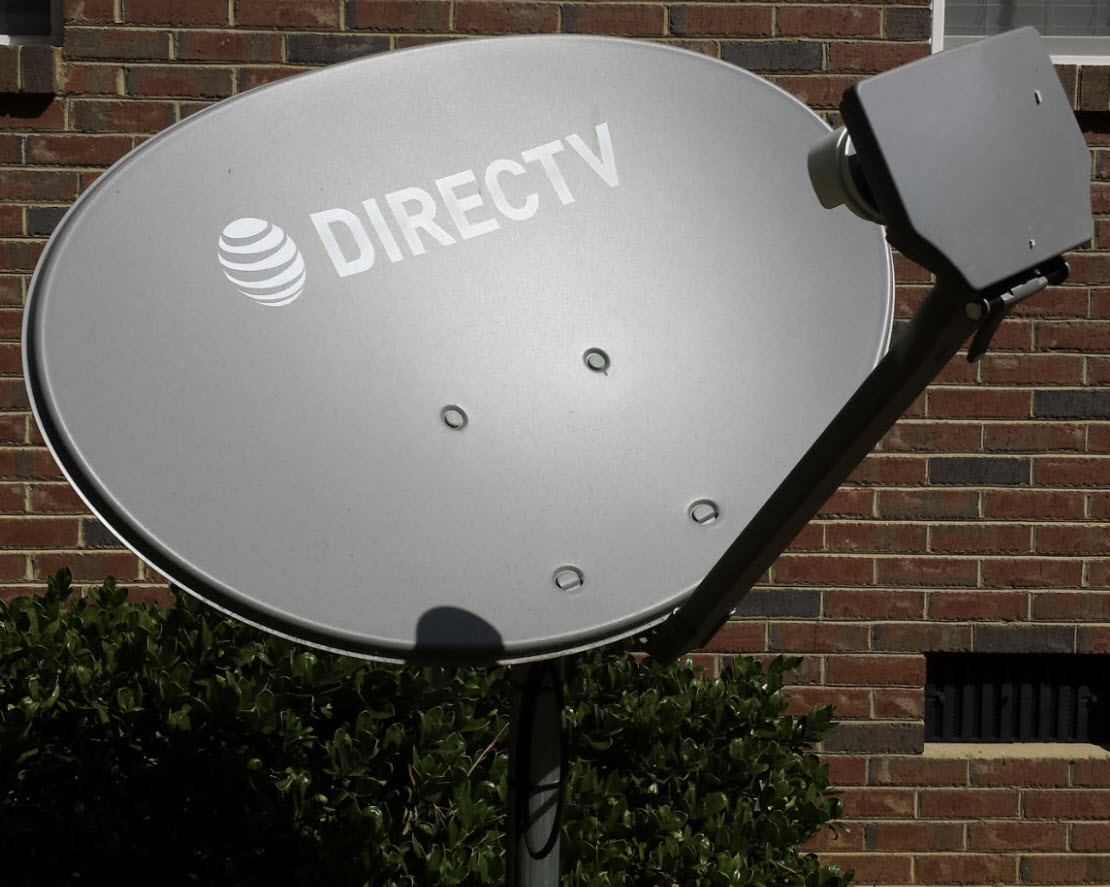
 Parabolic
microphone: When
we first moved to our present home I had high hopes for the
DIRECTV
satellite dish that previous owners had left in the back yard—or I
suppose the company abandoned it when the customer discontinued
service. That must be common practice, as unused TV satellite
dishes can be found all over.
Parabolic
microphone: When
we first moved to our present home I had high hopes for the
DIRECTV
satellite dish that previous owners had left in the back yard—or I
suppose the company abandoned it when the customer discontinued
service. That must be common practice, as unused TV satellite
dishes can be found all over.
The photo shows only the
front of the dish. On the back was an adjustable azimuth-elevation
mount, which by itself was sure to be useful. Maybe the whole thing
could be repurposed as a ham radio microwave antenna, or a receive
antenna for the NOAA
GOES satellite. If not, perhaps a different dish could be attached to
the adjustable mount.
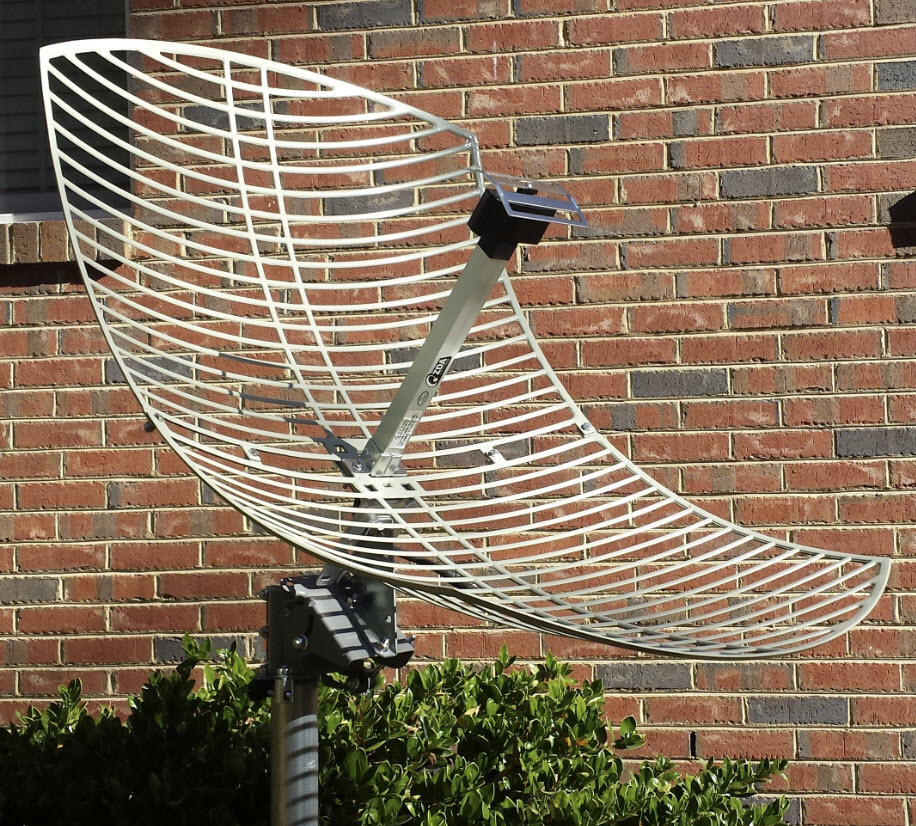
Time passed. Eventually I stowed the satellite TV dish in the garage
and
bolted a different antenna to the mount (photo right). That antenna has
nothing to do with the present project, however. For that matter, it is
only incidental to the current project that I used the DIRECTV dish as
a sound
reflector—Others have used trash can lids or stripped out patio
umbrellas,
basically any big curved thing that does not absorb sound.
The plan literally
fell into place. As I was retrieving the dish from the garage floor, a
nearby piece of aluminum bar stock fell over. It
appeared to be the same width as some LM386-based amplifier boards that
were on-hand (1/2 inch), and it could be easily cut and bent. A piece
of
Plexiglas could be glued to the underside of an amplifier board to
insulate it from the bar. Then to make the microphone’s position
adjustable, the insulated amplifier could be secured to the bar with
rubber bands. Although the plan was
simple and seemed foolproof, I was not entirely confident it would
work.
There’s usually a catch.
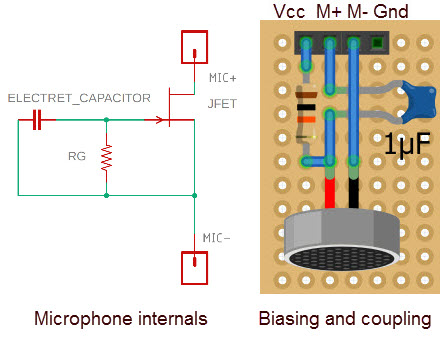
Electret
microphone: The
small condenser microphone is actually a circuit. The ‘button’
shaped device has an internal JFET for preamplification. If the JFET is
not biased, the microphone’s
output will be
insufficient to drive an LM386. Another consideration is coupling a
biased microphone to
the op amp input pin. The pre-made circuit board did not have a
capacitor
between the input header and pin 3 of the LM386—just a trimmer
potentiometer for level adjustment. Thus the microphone adapter would
need to include a coupling capacitor.
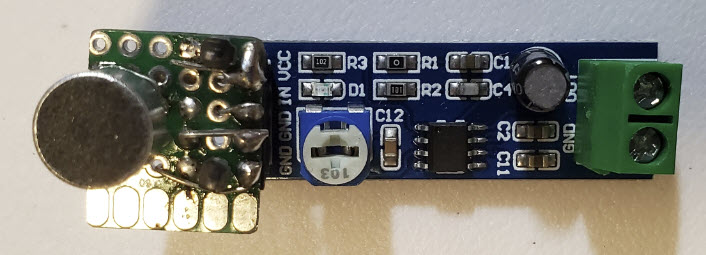
I planned to power the LM386 with a
9-volt battery, so used a
10K resistor for bias. The idea was
for the adapter to plug into the LM386 board. Actualization of
this idea
(right) was rather messier than the Fritzing diagram (above). The
resistor and
capacitor are on the underside of the small add-on board (opposite side
from the microphone). I used a 4-wire shielded cable for power and
audio output. Two male header
pins, for through-connecting Vcc and
ground to the LM386, are
difficult to see in the photo.
The terminal block at the other end of the assembly is the output.
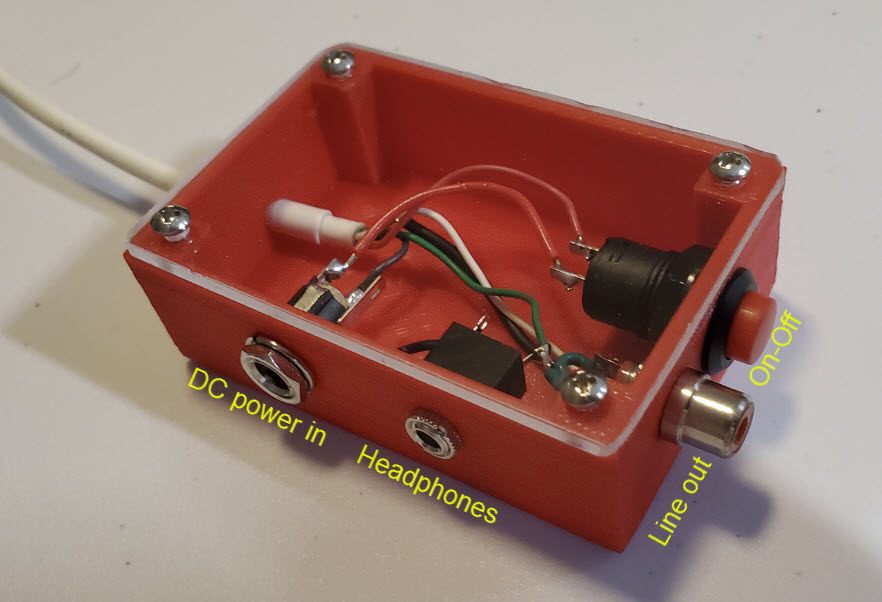
The original DIRECTV dish included a heavy-duty arm to which the
LNA/antenna box was attached. (I don’t know the proper terms for these
parts.) For distributing power and audio output, I printed an
enclosure the same width as this gray steel arm (2 inches). The
enclosure top is a cut
piece of Plexiglas, same as used to insulate the amplifier PCB. (It is
not weatherproof.) I accidentally interchanged the power and line out
jack hole diameters in
FreeCAD, but decided not to reprint the box.
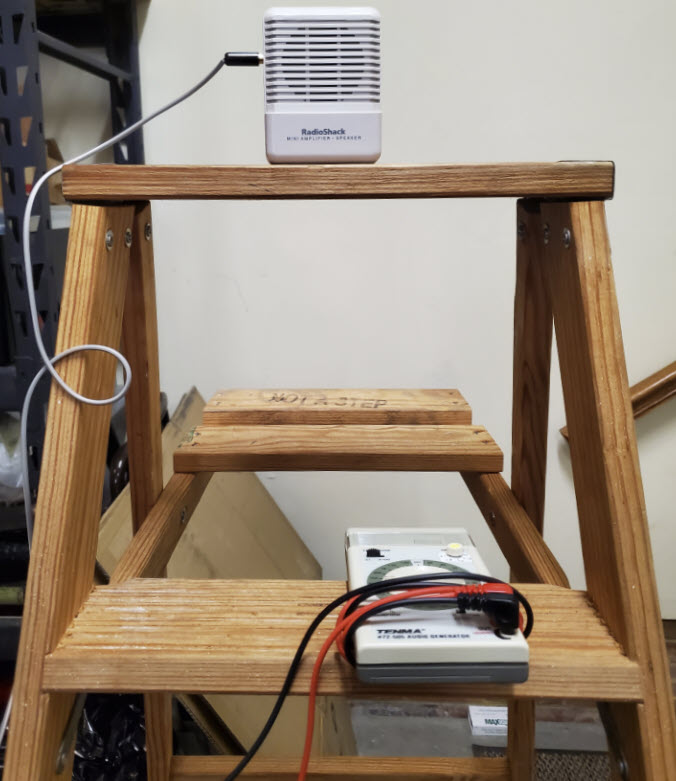 Positioning
the
microphone: Somehow I had expected a sharp focus, like
the solution to an algebra problem would be. To find this hypothetical
point I placed a tone oscillator at the other side of the garage from
the dish, making the volume as low as possible. Although the tone
could still be heard by the unaided ear, snug-fitting headphones
blocked the sound. Holding the microphone (and attached amplifier) in
my hand
and slowly waving it about through the space in front of the dish
identified a
focus zone that was much larger than I had thought it should be. It was
clearly a zone of reflected sound, as positioning the microphone
outside the
region attenuated tone volume in the headphones. But it was not a small
or exact location, as had been imagined. Another
surprise was the level of background sound that was being reflected
into the microphone. I could almost hear myself breathe, and became
aware of jingling keys in my pocket.
Positioning
the
microphone: Somehow I had expected a sharp focus, like
the solution to an algebra problem would be. To find this hypothetical
point I placed a tone oscillator at the other side of the garage from
the dish, making the volume as low as possible. Although the tone
could still be heard by the unaided ear, snug-fitting headphones
blocked the sound. Holding the microphone (and attached amplifier) in
my hand
and slowly waving it about through the space in front of the dish
identified a
focus zone that was much larger than I had thought it should be. It was
clearly a zone of reflected sound, as positioning the microphone
outside the
region attenuated tone volume in the headphones. But it was not a small
or exact location, as had been imagined. Another
surprise was the level of background sound that was being reflected
into the microphone. I could almost hear myself breathe, and became
aware of jingling keys in my pocket.
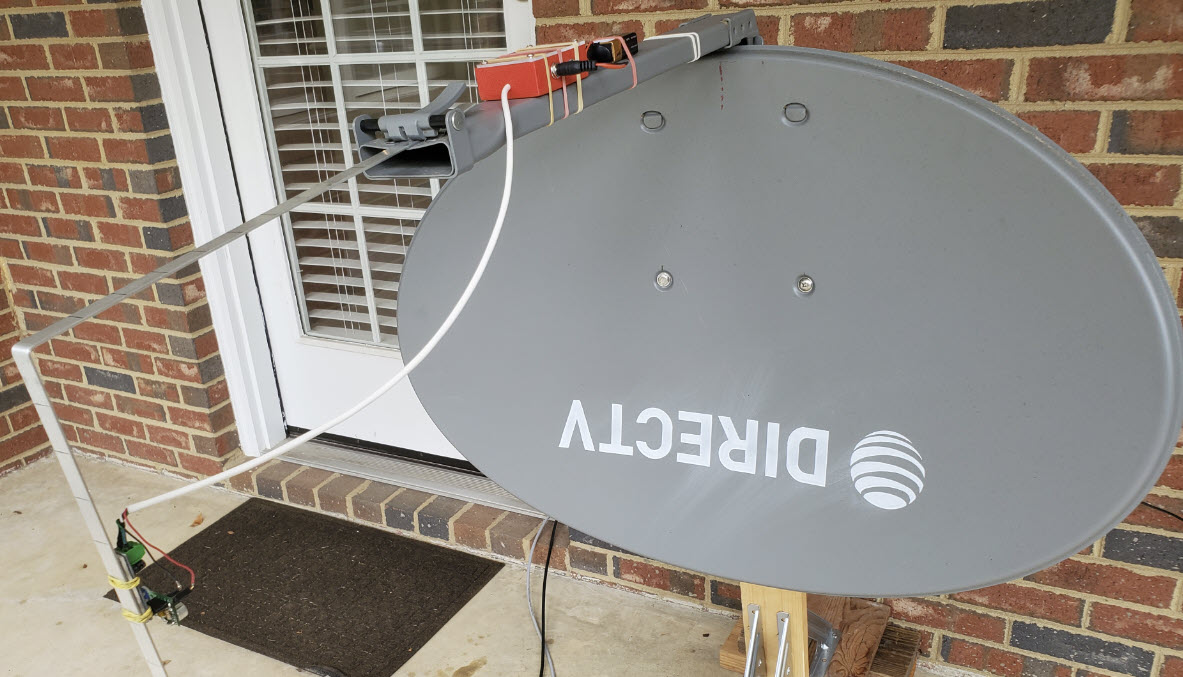
Having identified approximately where the microphone should be
positioned, I cut
and bent the aluminum slat and put the rest of the assembly together.
Later I moved the whole thing to the back porch in order to listen to
outside sounds, which in the daytime consist mainly of passing cars! My
wife assisted in a field test of sorts by walking toward the back of
the lot and speaking at a conversational level. With amplification it
was possible to make out what she was saying. Such subjective
impressions are not trustworthy. Nevertheless we both agreed that the
setup was collecting more sound than could be heard or would be noticed
without acoustic amplification.
The dish does not exhibit much directionality with respect to sound
sources. I guess its apparent original purpose of detecting weak RF
energy from a point in the sky led me to imagine that aiming it toward
a distant bird would pick up that bird’s song more prominently than
background sounds. That was an erroneous expectation! So far, the
most interesting outside sounds are heard at dusk. Unfortunately that
is also the time when mosquitos swarm, or whatever it is they do.
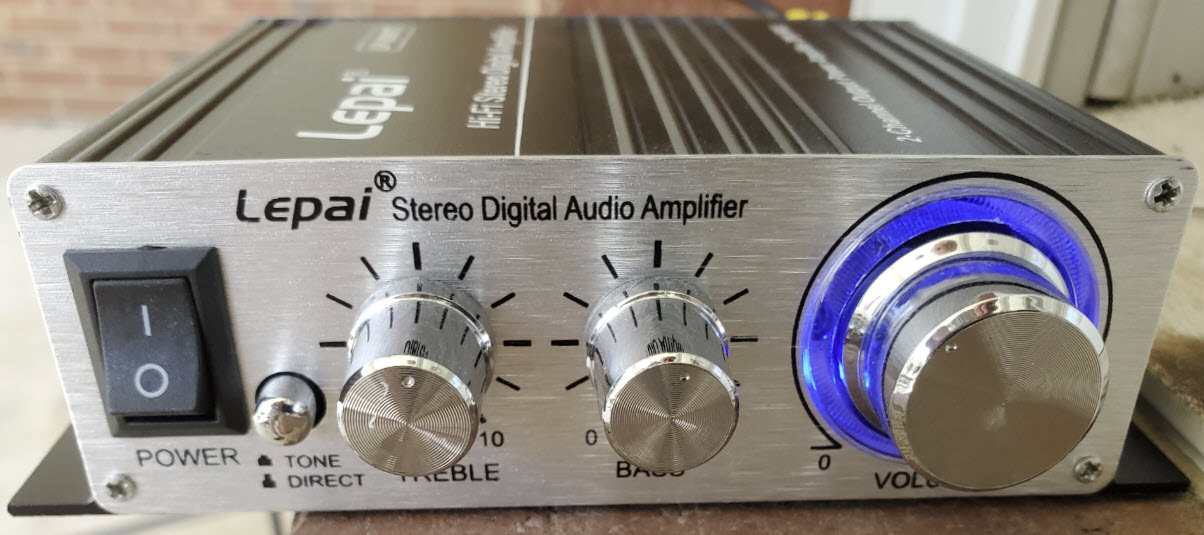
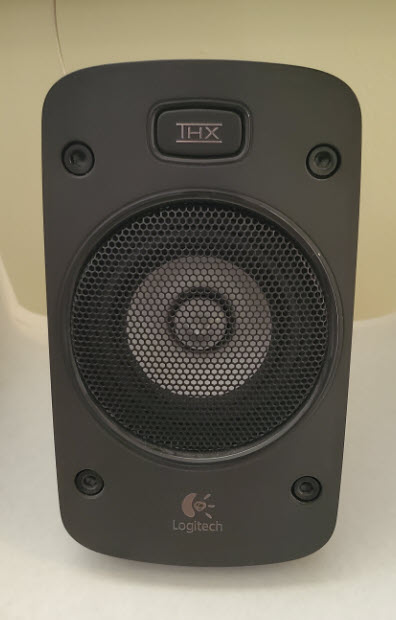 An
obvious antidote for the mosquito problem was to place a speaker inside
the house. To that end I set a small amplifier on the outside window
ledge and ran a short speaker wire under the window to the adjoining
room. (This was not to be a permanent installation!) What can I say?!
It was nice to hear birds chirping and other outdoor sounds along with
the high-pitched whine of the 3D printer and the chug-a-chug of the
washing machine. Later, in the quiet of the evening—oops, there is no
quiet in the evening, or night—Anthropogenic
noise intrudes at all hours of day and night.
An
obvious antidote for the mosquito problem was to place a speaker inside
the house. To that end I set a small amplifier on the outside window
ledge and ran a short speaker wire under the window to the adjoining
room. (This was not to be a permanent installation!) What can I say?!
It was nice to hear birds chirping and other outdoor sounds along with
the high-pitched whine of the 3D printer and the chug-a-chug of the
washing machine. Later, in the quiet of the evening—oops, there is no
quiet in the evening, or night—Anthropogenic
noise intrudes at all hours of day and night.
Although out-of-doors is quieter in early morning, the background hum in the recording is an electric motor that never stops running—It is about 100 meters from the microphone.
Recording: Morning
Project descriptions on this page are intended for entertainment only.
The author makes no claim as to the accuracy or completeness of the
information presented. In no event will the author be liable for any
damages, lost effort, inability to carry out a similar project, or to
reproduce a claimed result, or anything else relating to a decision to
use the information on this page.