Why?
A recent story in Science
(26 February 2021) caught my eye. It described a method of generating
(true) random numbers at very high
speed using laser light. I had previously encountered explanations of
quantum random numbers, for example, at this
web page from The Australian National
University. Another
fascinating project, called HotBits, addresses the subject at
an amateur level.
Anything having to do with quantum
physics may be inaccessible to non-specialists. However, on
reading about physical generation of random numbers, and in particular
about the kind that relies on the fundamental randomness
of nature at its
smallest scale, I wondered if it
would be feasible to generate good quality random numbers from
electronically produced so-called ‘white’ noise.
While I know almost nothing about physics, I do know a little about
noise. As
an amateur radio operator I have observed many different types
of noise that affect the quality of radio reception. The diagram below
summarizes my first effort at producing random numbers from
electronically-produced noise.
Generating
noise: I constructed the circuit described on this page, substituting a C1815
transistor for the specified BC182L, which I did not have. Noise is
produced at the
reverse biased emitter-base junction of this transistor. (The
collector is not connected.) The rest of the
circuit is identical to the referenced one, except that instead
of 9 volts I used a
12 volt battery for power.
The circuit works fine with a bench power
supply
or brick, but I thought a battery would avoid possible power supply
hum. See also the
composite
circuit diagram below.
Transistor
junction
I also experimented with generating
white noise using a Zener diode (this circuit). However, the audio
part of the generated spectrum included an intermittent ‘popping’ on
top of otherwise uniform-sounding white noise. In an effort to get rid
of the ‘pops’ I slowly
reduced power-supply
voltage
toward the diode’s Zener
voltage (below which there is no noise). But while noise amplitude
steadily decreased as voltage was lowered, the relative amplitude of
‘pops’ was unaffected. Other Zener diodes also produced the
symptom, which remains unexplained for the present.
Zener
diode
Amplifying
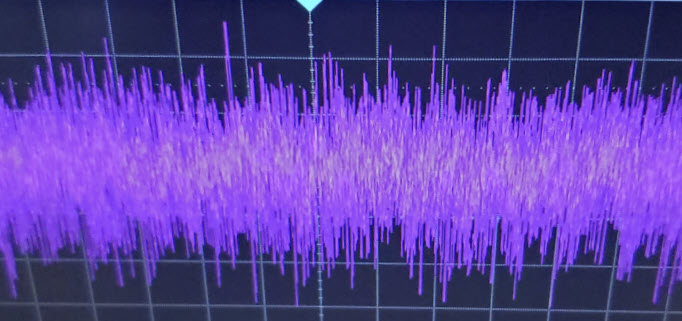
and Conditioning: In this project noise itself is the
signal of interest. Thus instead of seeking to improve signal-to-noise
ratio, the challenge was to condition the noise for further processing.
In a previous project and this related
one I had repurposed the
pre-amplifier section of the Four
State QRP Group Frequency Mite kit, so I thought to use the
same amplifier circuit again for the
present project. Once again transistors were substituted, 2N3904’s
in place of the 2N4401’s
in the 4SQRP kit—No 2N4401’s were available from the parts
bin. After amplification, peak noise amplitude was
sufficient to drive transistor-transistor logic gate inputs
(TTL).
The pre-amplifier shared power from the
5-volt pin of an Arduino Uno, which was powered via
the USB cable from the desktop computer. Two
series NAND gates buffered the pre-amp output, which in turn drove the
input of a 74HC4040 12-bit
counter IC. I experimented with different divisors to ascertain a value
that
produced sufficient variability of inter-pulse
times in Arduino, and at reasonable speed (frequency). This
led to selecting Q9 as the divisor, although
neighboring divisors also work. Q9 output was then fed through
NAND gates (same
as the input) to an Arduino interrupt pin (digital I/O
pin 2). These component circuits and their interconnections
are
shown in the composite schematic below.
Harvesting
data: A very simple Arduino sketch captures time data
and transmits time deltas to the desktop computer. On the computer end,
the RS232 program Termite receives the serial data
stream, although the
Arduino IDE’s serial monitor would work as well. Having ascertained an
approximate rate of data generation, I let the program run long enough
to produce a target quantity of data, and then copied and pasted time
deltas
from
Termite (or the IDE’s
serial monitor) to a text file.
From the time deltas text file, data are
then processed using an analog of the algorithm that HotBits uses to
generate ‘true’ random numbers (see link above), but implemented in a
different programming language. This times-to-numbers processing step
is easy
and could be
coded in any programming language. My improvised
code
may serve as a guide (like pseudo-code) for processing steps that
produce datasets of
random numbers for testing/analysis using the dieharder
suite (Linux) or the NIST random number statistical assessment
tool ‘assess’.
Speed and
Quality: If research grade random number generators are
‘ultra-high bandwidth’, then this project would qualify as an
‘ultra-slow’ physical random number generator. In early testing the
procedure generated fewer than 60 bits per
second.
Now it is about 110 bits per second. With luck, production rate may
continue to improve a little, as parameters are tweaked, or further
adjustments are made to
the
algorithm.
The largest
dataset generated in a single
run
(so-far) is 1,628,240 bits (about 4 hours). This fairly large dataset
passed all of the more than 150 NIST suite components and had just 4
‘weak’ findings from the dieharder
suite. A small number of weak results may be expected in a large pool
of probability calculations. Other smaller datasets also passed all
NIST assess
tests, with no more than 1 to 3 dieharder
‘weak’ findings.
Interference:
For this project I made throw-away circuits on breadboards, with no
effort to shield them from interference. For serious work it
would be necessary to construct more robust circuits, and with proper
shielding, so that other noise sources would not confound the
intentionally generated—relatively uniform—broadband noise. During
testing, RFI was found to affect the noise spectrum. Even
household laundry appliances appeared to have an effect. To avoid
contamination from such non-random sources, data acquisition was
limited to quiet periods.
Summary:
Pseudo-random numbers (glossary below) are widely used, and of course,
are part of
the programmer’s toolkit. In some contexts physical events may be used
to seed a pseudo-random number generator, for example, the time of a
keypress or mouse click. I do not know what sorts of applications
require physical random numbers, or the extreme of ‘true’ randomness,
in place of the common pseudo-random sequences. The lottery relies on a
physical
process (bouncing ping-pong balls), but do any mathematical or physical
investigations require such numbers? Maybe it is a matter of
confidence. The knowledge that a pseudo-random sequence is
reproducible, however remote the possibility of that happening, causes
our minds to drift randomly toward alternative options.
Mini-Glossary:
[Made-up definitions, not claimed to be rigorous.]
Pseudo-random
number (RN) - produced by a mathematical algorithm that
was possibly seeded from a random event. Distributions of pseudo-random
numbers pass multiple tests of randomness, but in principle can be
reproduced from knowledge of the algorithm and its seed.
Physical random
number (PRN) - produced from a putatively random physical
process or mixture of such sources, such as resistor noise.
True random
number (TRN) - AKA Quantum Random Number.. generated from
a fundamentally random physical process, such as the time of decay of a
radioactive atom.
Project descriptions on this page are intended for entertainment only.
The author makes no claim as to the accuracy or completeness of the
information presented. In no event will the author be liable for any
damages, lost effort, inability to carry out a similar project, or to
reproduce a claimed result, or anything else relating to a decision to
use the information on this page.

 Amplifying
and Conditioning: In this project noise itself is the
signal of interest. Thus instead of seeking to improve signal-to-noise
ratio, the challenge was to condition the noise for further processing.
In a previous project and this related
one I had repurposed the
pre-amplifier section of the Four
State QRP Group Frequency Mite kit, so I thought to use the
same amplifier circuit again for the
present project. Once again transistors were substituted, 2N3904’s
in place of the 2N4401’s
in the 4SQRP kit—No 2N4401’s were available from the parts
bin. After amplification, peak noise amplitude was
sufficient to drive transistor-transistor logic gate inputs
(TTL).
Amplifying
and Conditioning: In this project noise itself is the
signal of interest. Thus instead of seeking to improve signal-to-noise
ratio, the challenge was to condition the noise for further processing.
In a previous project and this related
one I had repurposed the
pre-amplifier section of the Four
State QRP Group Frequency Mite kit, so I thought to use the
same amplifier circuit again for the
present project. Once again transistors were substituted, 2N3904’s
in place of the 2N4401’s
in the 4SQRP kit—No 2N4401’s were available from the parts
bin. After amplification, peak noise amplitude was
sufficient to drive transistor-transistor logic gate inputs
(TTL).


